DECODING GENOME

0%

MSc Bioinformatics · University of Birmingham

Nika Hasanzad

MSc Bioinformatics student at the University of Birmingham, developing a research direction around computational and systems biology, multi-omics and the study of biological organisation, interactions and disease.

Research interests

About Me

Connecting biology and computation

I have a background in cellular and molecular biology and am now an MSc Bioinformatics student at the University of Birmingham. I'm interested in connecting biological questions, molecular data and computational approaches.

I'm developing a systems-oriented perspective on biological organisation, interactions and disease. I value interdisciplinary research, careful interpretation and collaboration.

Biological Questions
Where the work starts
Data & Computation
How I investigate them
Systems Thinking
How I frame them
Research Collaboration
How I like to work

Journey

  1. Foundation

    Cellular & Molecular Biology

    A BSc background in the biology behind the data.

  2. Experience

    Research & Laboratory Work

    Time spent in research and laboratory settings.

  3. Now

    MSc Bioinformatics

    Studying at the University of Birmingham.

  4. Developing

    A Systems Perspective

    Shaping a research direction around biological organisation, interactions and disease.

Research Vision

An evolving map of connected ideas

My developing vision centres on understanding biological organisation, interactions and the changes associated with disease through computational and systems-level approaches. These are directions I want to explore, not a list of established expertise.

Biological Questions

Research interest

Intellectual foundations

How I frame questions: what biological organisation means, and why relationships may matter as much as parts. These ideas inform my thinking; no particular algorithm implements them.

Biological organisationRelational thinkingTheoretical perspectives

A conceptual map, not data. Connections show how ideas relate; they are not prerequisites, causal claims or a sequence every project follows.

Questions I'd like to explore

Open directions, not claims that my current projects answer them.

When do relationships between biological components add insight beyond the properties of individual components?

How do biological context and cellular composition influence the patterns we observe?

How can data, models and validation help us investigate changes in biological systems?

Emerging interest

Expanding horizons

I am interested in understanding and potentially engineering living systems, and in the future possibility of developing biological tools and technologies using computation and AI. Synthetic biology and AI-driven biological design are areas I want to learn about, not work I have carried out.

UnderstandPredictInterveneEngineer
Projects

Projects & research

Principal projectv0.1.0-rc3

TCGA-BRCA Clinical Association Analysis

An exploratory analysis of associations between tumour gene expression, age at diagnosis and pathological stage using TCGA-BRCA data. The project integrates bulk RNA-seq and clinical information through a documented statistical workflow.

RBulk RNA-seqClinical datalimma/voom

Findings are associations and do not establish causation or clinical utility. There has been no independent biological or clinical validation, and clean restoration, remote CI and full-data reproduction remain untested. Further project extensions are being explored.
Earlier concept · Not pursued

Microbiome concept

An earlier, unpursued research concept exploring computational approaches to microbiome–immune interactions and precision medicine.

Concept stage · Analysis not yet started

SLE concept

An early collaborative concept concerning the potential study of RNA regulation in systemic lupus erythematosus using transcriptomic data.

University Projects

Coming soon

Scientific Web Apps

Coming soon
From the TCGA-BRCA project

Selected visualisations

Two figures from the repository, shown with their documented context. They describe statistical associations in one cohort.

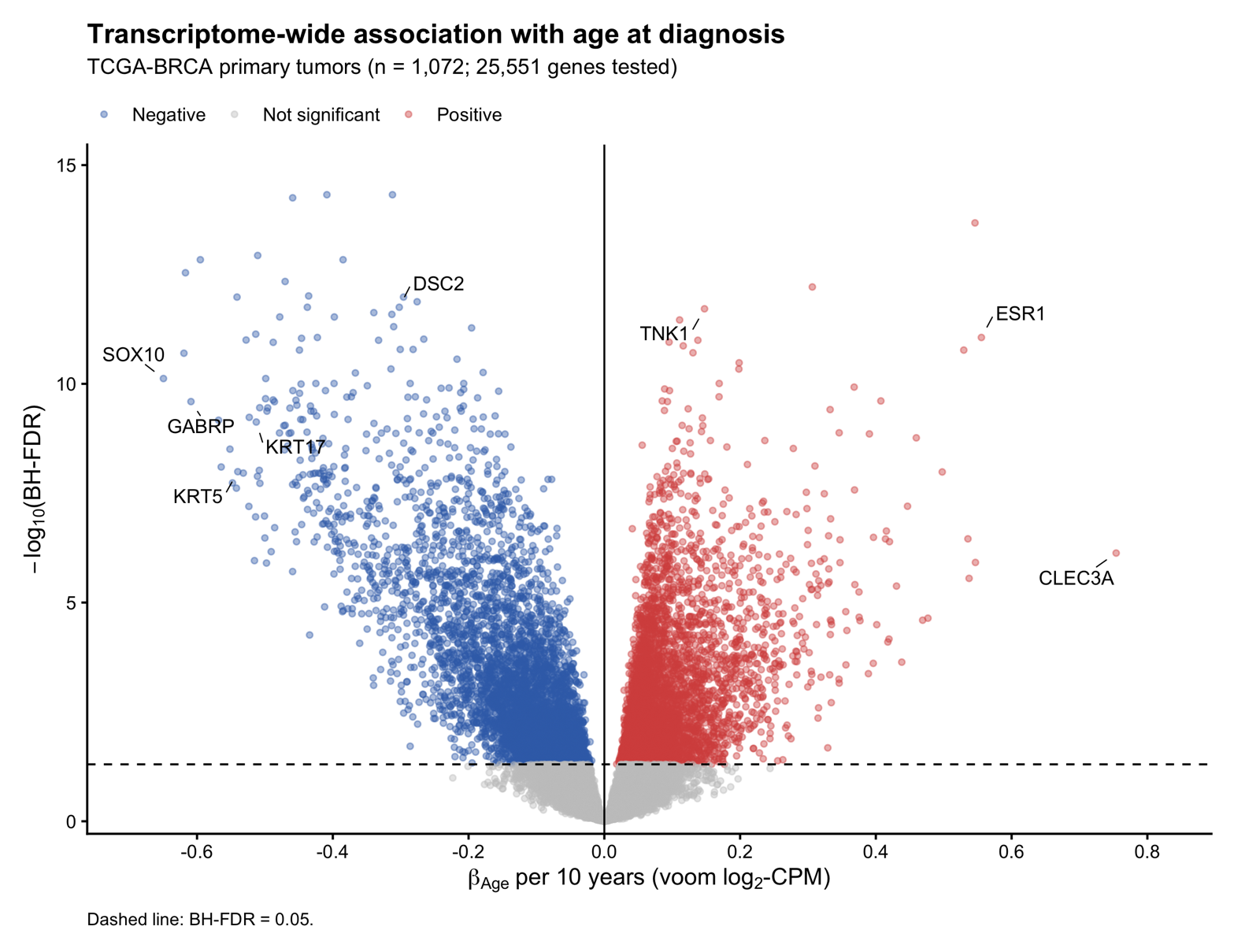
Volcano-style plot from the TCGA-BRCA primary Age model: age coefficient per 10 years on the horizontal axis, minus log10 BH-FDR on the vertical axis, with a dashed line at FDR 0.05.
Figure 1

Age transcriptome-wide association

Primary Age model, 1,072 tumours and 25,551 tested genes: the age coefficient per decade against −log10 BH-FDR, with the dashed line at 0.05. This is an association display, not a causal ageing effect.

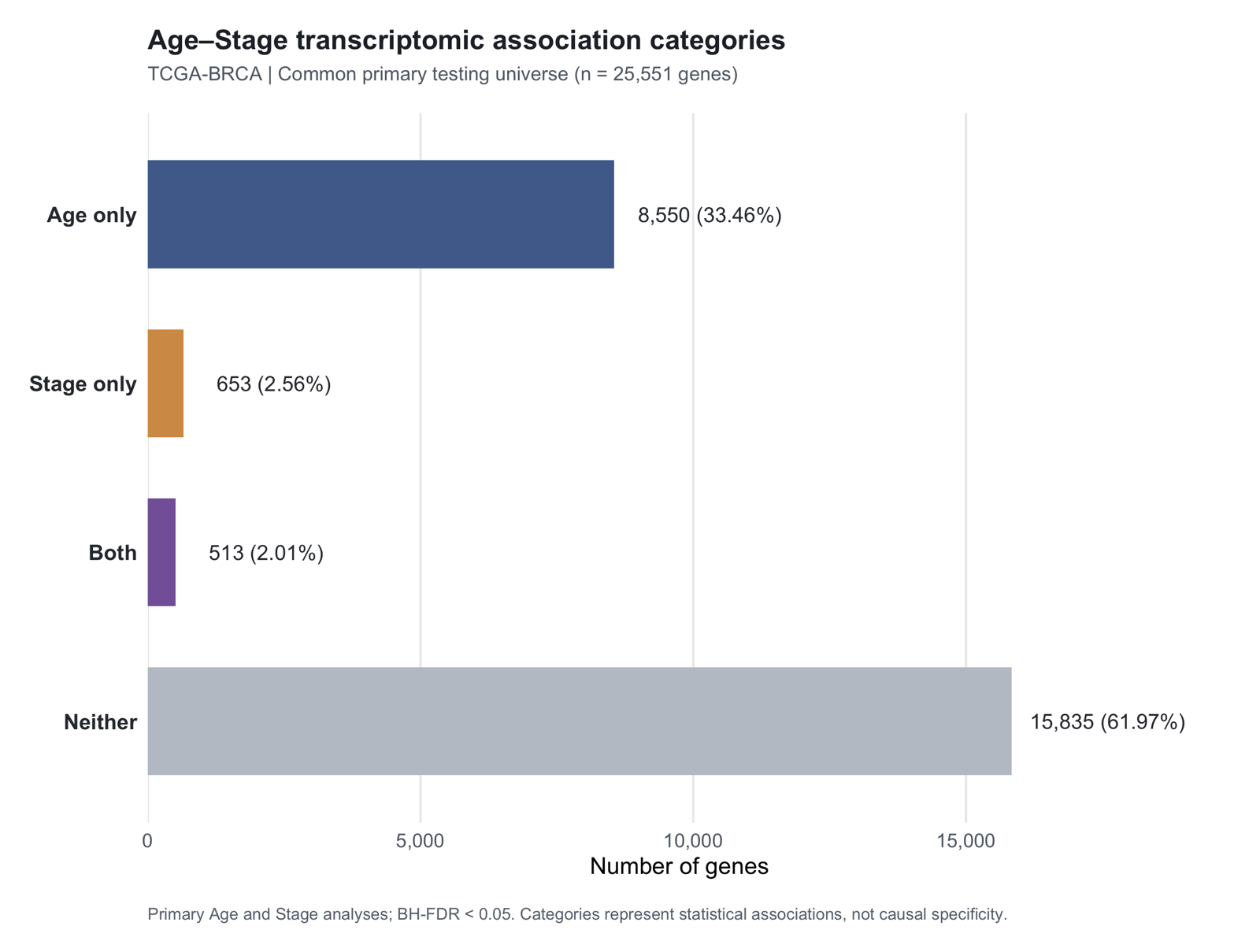
Bar chart of 25,551 genes by category: Age only 8,550, Stage only 653, Both 513, Neither 15,835.
Figure 7

Primary association categories

Within the common 25,551-gene universe, original-family FDR defines Age only, Stage only, Both and Neither. The primary analyses have different eligible cohorts, and a shared category is not a mechanistic interaction or an independently tested biomarker class.

Figures by Nika Hasanzad, TCGA-BRCA clinical association analysis v0.1.0-rc3, licensed under CC BY 4.0 and resized for the web. Data: TCGA Research Network, accessed through the NCI Genomic Data Commons. Read the full figure legends.

Skills

Skills & approaches

What I have used or studied, and where. Select a node to see the context, or filter by category.

Context

Programming & Data Analysis

R

The language of the TCGA-BRCA pipeline, from data handling to models and figures.

Experience

Education & experience

PostgraduateCurrent

MSc Bioinformatics

University of Birmingham

Undergraduate

BSc Cellular and Molecular Biology

My background in the biology behind the data.

Research

Research & Laboratory Experience

Experience working in research and laboratory settings.

Training

From Code to Web App

Course training that also informs the scientific web apps I hope to build.

Contact

Let's start a conversation

I'm always happy to connect about research conversations and interdisciplinary collaboration.

Email Me